Multiagent Systems Are Becoming the Quiet Control Plane for Enterprise AI
Why orchestration—not just smarter models—is becoming an important infrastructure layer in 2026.
For the past two years, a dominant question in enterprise AI has been which model to pick. Teams compared benchmarks, context windows and price lists, then standardized on a flagship LLM. Complex work—research spanning many sources, workflows touching internal systems and specialized compliance checks—can expose the limits of a single agent operating in isolation.
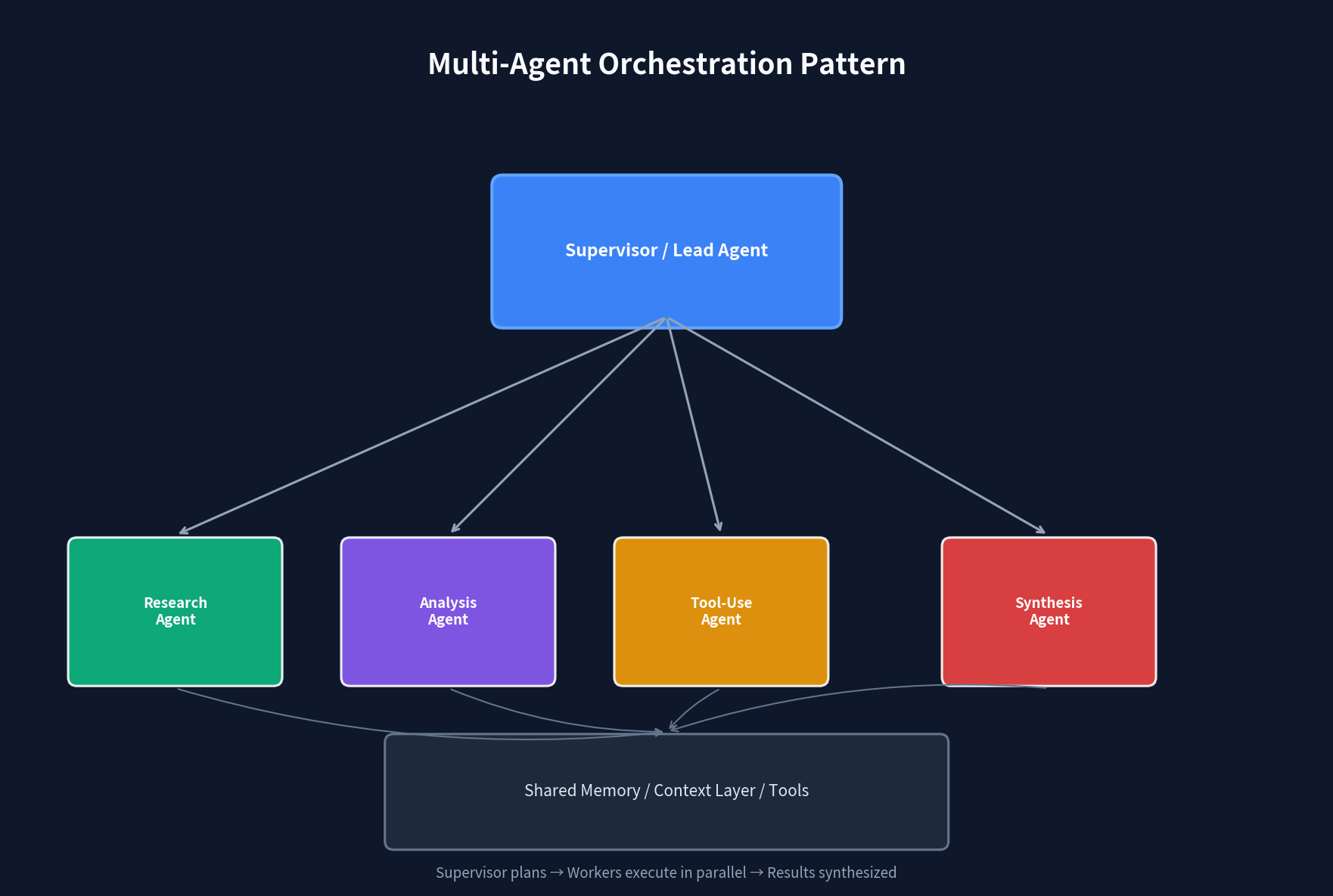
The emerging pattern is multiagent systems: specialized agents coordinated by an orchestration layer that plans, assigns, synthesizes and intervenes. Gartner listed multiagent systems among its [strategic technology trends for 2026](https://www.gartner.com/en/articles/top-technology-trends-2026). Its separate forecasts anticipate [40% of enterprise applications featuring task-specific agents by the end of 2026](https://www.gartner.com/en/newsroom/press-releases/2025-08-26-gartner-predicts-40-percent-of-enterprise-apps-will-feature-task-specific-ai-agents-by-2026-up-from-less-than-5-percent-in-2025), up from less than 5% in 2025, and [over 40% of agentic AI projects being cancelled by the end of 2027](https://www.gartner.com/en/newsroom/press-releases/2025-06-25-gartner-predicts-over-40-percent-of-agentic-ai-projects-will-be-canceled-by-end-of-2027) because of costs, unclear value or inadequate risk controls. These are forecasts, not observed adoption or cancellation rates.
Supplied conceptual architecture diagram. Actual systems require explicit permissions and state boundaries; shared context is not unrestricted shared access.
Why a single agent can hit a ceiling
An LLM agent can be effective at sequential reasoning and tool use within one context. It may struggle when work requires many independent lines of inquiry, different skills or durable coordination across long-running steps. Decomposition can help, but creates its own cost and coordination problems.
[Anthropic’s engineering account](https://www.anthropic.com/research/multi-agent-research-system) reports that its lead-agent Claude Opus 4 setup, with Claude Sonnet 4 subagents, scored 90.2% higher than a single-agent Opus 4 baseline on its internal research evaluation. The system typically used about 15 times as many tokens as a normal chat interaction. These are results for that specific research system and comparison—not a general capability improvement or universal cost multiplier.
Breadth-first questions can benefit from parallel investigation with separate contexts and a synthesis step, sometimes followed by a dedicated citation pass. Tasks with tightly shared dependencies or inexpensive answers may not justify the extra complexity.
Databricks’ [2026 State of AI Agents report](https://www.databricks.com/resources/ebook/state-of-ai-agents), based on activity from more than 20,000 organizations on its platform, reports 327% growth in multiagent systems in less than four months. That is vendor-platform telemetry, not a representative census of every enterprise. It is evidence of growth in the measured population, not proof that every organization should adopt the same architecture.
Core orchestration patterns
| Pattern | How it works | Main trade-off | | --- | --- | --- | | Supervisor / orchestrator-workers | A lead agent delegates specialized work and merges results | Clear coordination, but the supervisor can become a bottleneck | | Handoffs | Control passes to another agent for a domain or escalation | Useful specialization; state and authority must transfer safely | | Graphs / workflows | Explicit steps mix deterministic execution and model-driven choices | Predictable recovery, with more up-front workflow design | | Shared-memory groups | Agents collaborate through common context or a blackboard | Flexible, but greater coordination and contamination risk |
Frameworks including Microsoft Agent Framework, OpenAI Agents SDK, AWS Strands and Google ADK offer different building blocks for these approaches. Their semantics are not interchangeable; choose based on your workflow and verify the actual version’s behavior.
The practical principle is to start with one agent. Split when the work is broad, parallelizable and valuable enough to justify the additional tokens and operational burden. Put deterministic steps in code or a workflow engine; reserve model decisions for the variable parts.
The new infrastructure layer
Orchestration is becoming infrastructure rather than incidental application logic. The [Model Context Protocol](https://modelcontextprotocol.io/introduction) connects applications to tools and data. The [Agent2Agent protocol](https://a2a-protocol.org/latest/) aims to support agent-to-agent interaction. These protocols address different boundaries; neither makes agents automatically trustworthy or interchangeable in every deployment.
A control plane decides which agent or model runs, what context it receives, which tools it may call, how failures are handled and when a human must intervene. It should remain useful when a model is replaced or a workflow resumes after a failure.
The difficult problems are not hidden by adding more agents:
- Identity and permissions: non-human actors need narrowly scoped authority, not shared administrator credentials. - Observability: traces should connect plans, tool calls, handoffs, approvals and final outcomes. - Evaluation: measure end-to-end correctness, not only single-turn fluency or successful demos. - Durable state: preserve completed work and recover safely after crashes, retries or long waits. - Cost control: limit tokens, parallel workers, tool calls and retries against the value of the task. - Governance: maintain an inventory of agents, owners, permissions and deployment boundaries.
What changes for builders and buyers
Treating multiagent systems as more prompting can leave costs, authority and recovery undefined. Gartner’s cancellation forecast is a warning to examine these risks, not a fixed failure rate that every team must hit.
Builders should define agent contracts: inputs, outputs, allowed tools, escalation conditions and evidence requirements. Create task-specific evaluation suites and test partial failures. A worker that times out should not silently erase a result or cause an irreversible action to run twice.
Buyers should ask for observed business outcomes and representative operating costs. A vendor’s internal benchmark gain or rapid platform adoption does not establish performance on your documents, permissions or customer workflows.
The bottom line
The competitive edge may shift from choosing the smartest model to composing specialized agents into workflows that survive production. Multiagent orchestration will not replace single agents for simple tasks, and it is not automatically the best architecture for every work queue or research project.
It is a consequential infrastructure layer when coordination is genuinely needed: less flashy than a frontier model release, but central to whether AI stays reliable after the demo.
Sources and editorial notes
- [Gartner: Top strategic technology trends for 2026](https://www.gartner.com/en/articles/top-technology-trends-2026) - [Gartner: Task-specific AI agents forecast](https://www.gartner.com/en/newsroom/press-releases/2025-08-26-gartner-predicts-40-percent-of-enterprise-apps-will-feature-task-specific-ai-agents-by-2026-up-from-less-than-5-percent-in-2025) - [Gartner: Agentic project cancellation forecast](https://www.gartner.com/en/newsroom/press-releases/2025-06-25-gartner-predicts-over-40-percent-of-agentic-ai-projects-will-be-canceled-by-end-of-2027) - [Anthropic: How we built our multiagent research system](https://www.anthropic.com/research/multi-agent-research-system) - [Databricks: State of AI Agents 2026](https://www.databricks.com/resources/ebook/state-of-ai-agents) - [MCP documentation](https://modelcontextprotocol.io/introduction) - [A2A documentation](https://a2a-protocol.org/latest/)
Reviewed November 7, 2026. Analyst forecasts and vendor measurements are attributed and not independently replicated. The draft’s illustrative 15%/45%/100% adoption chart was omitted because it was not measured data. Its misspelled site footer and unsupported universal-adoption language were corrected.
Related reading
- [Multiagent Systems: Observability Is the Real Production Gate](https://reviuws.com/blog/multiagent-systems-observability-production-gate) - [AI Agents Need a Reliability Scorecard](https://reviuws.com/blog/ai-agent-reliability-scorecard-outcomes-not-task-completion)
Referenced sources
- strategic technology trends for 2026
- 40% of enterprise applications featuring task-specific agents by the end of 2026
- over 40% of agentic AI projects being cancelled by the end of 2027
- Supervisor coordinates research, analysis, tool-use and synthesis agents sharing context and tools
- Anthropic’s engineering account
- 2026 State of AI Agents report
- Model Context Protocol
- Agent2Agent protocol
- Gartner: Top strategic technology trends for 2026
- Gartner: Task-specific AI agents forecast
- Gartner: Agentic project cancellation forecast
- Anthropic: How we built our multiagent research system
- Databricks: State of AI Agents 2026
- MCP documentation
- A2A documentation
- Multiagent Systems: Observability Is the Real Production Gate
- AI Agents Need a Reliability Scorecard