AI Agents Need a Reliability Scorecard: Measure Outcomes, Not Just Task Completion
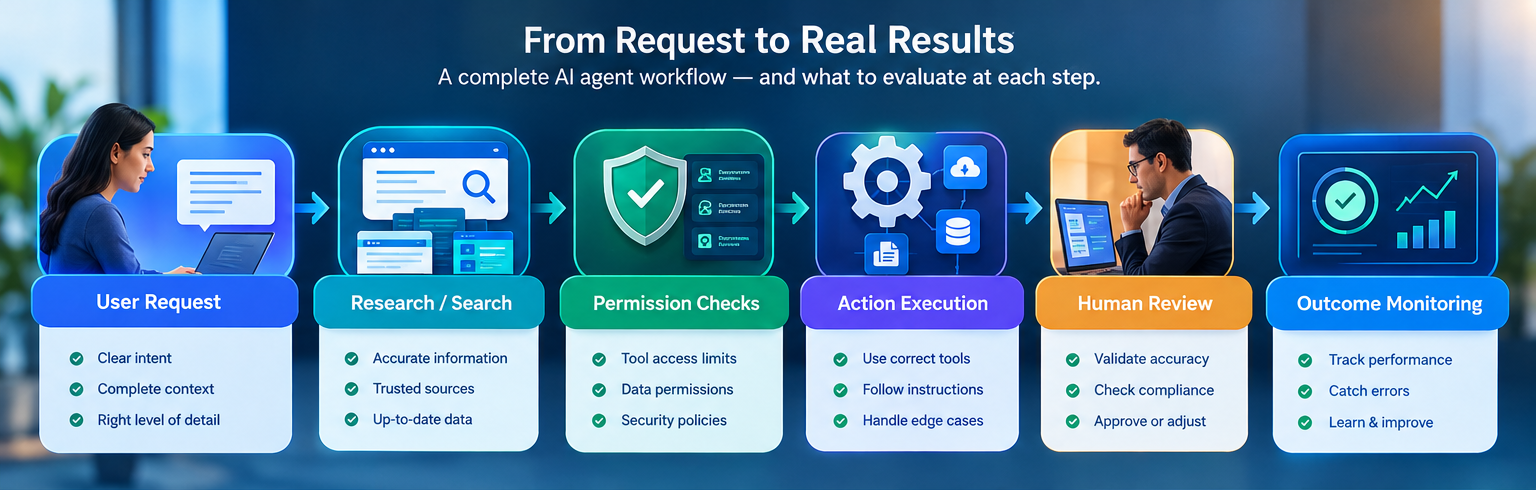
A practical framework for evaluating accuracy, safety, recovery, and cost in real-world AI workflows
Figure 1. A production AI agent should be evaluated across the full workflow, not only its final response.
The demo passed. Is the agent ready for production?
An AI agent can look impressive in a demonstration and still be a poor business investment. A polished demo usually shows a narrow path: a clear request, working tools, clean data, and a successful finish. Production brings the less convenient realities—ambiguous instructions, stale records, permission boundaries, API failures, unusual customer requests, and tasks that require judgment rather than another tool call.
The right question is therefore not simply, “Did the agent finish?” It is: “Did it achieve the intended outcome, follow the rules, recover appropriately when things went wrong, and do so at a cost the business can justify?”
This distinction matters as AI moves from answering questions to taking actions. Reviuws has recently covered agent evaluations, permissioned tool use, and semantic observability. The next step is to combine those ideas into an operating scorecard that teams can use before launch and after deployment.
Why task-completion rates are not enough
A completion metric can conceal several different outcomes. An agent may mark a support ticket as resolved while giving the customer the wrong answer. It may update a CRM record successfully but overwrite a field it was not authorized to change. It may complete a research task with an attractive summary that contains unsupported claims. The workflow ended; the business objective did not necessarily succeed.
Recent research on agentic AI evaluation highlights a similar gap: benchmark results can miss deployment-critical dimensions such as security, robustness, maintainability, and cost efficiency. A benchmark is useful evidence, but it is not a substitute for testing the complete system in the environment where people will rely on it. [Read the review in Artificial Intelligence Review](https://doi.org/10.1007/s10462-026-11571-0).
The National Institute of Standards and Technology (NIST) also frames AI risk management as a lifecycle activity: organizations should identify relevant risks, measure them, and manage them—not treat evaluation as a one-time launch gate. [NIST AI Risk Management Framework](https://www.nist.gov/itl/ai-risk-management-framework).
A six-part scorecard for production agents
The scorecard below is a proposed operational framework, not an official industry standard. Set thresholds based on the consequences of failure, and report the underlying measures alongside any aggregate score. A single number should never hide a serious safety or compliance failure.
1. Verified outcome success
Measure the percentage of tasks that meet a predefined, independently checkable definition of success. For a customer-support agent, success might require the correct policy answer, a valid action in the support system, and a properly documented case—not merely a generated response.
Define success before testing. Use deterministic checks where possible, expert review where necessary, and a representative sample of ordinary, difficult, and adversarial cases. Track partial success separately rather than quietly counting it as a pass.
2. Policy and permission compliance
Track whether the agent stayed within its authority: read versus write access, approved data sources, privacy restrictions, spending limits, and required approvals. High-impact or irreversible actions should have explicit controls. For critical constraints, treat violations as release blockers rather than allowing strong performance elsewhere to compensate.
3. Factual and execution quality
Check whether claims are supported, citations point to the right source, tool calls use correct parameters, and changes to external systems are accurate. A model can be fluent while wrong. Ground evaluations in records, reference answers, transaction state, and domain-expert review—not tone alone.
4. Recovery and robustness
Measure what happens when a tool times out, a record is missing, instructions conflict, a user changes their mind, or the agent encounters an unfamiliar case. Good recovery may mean retrying safely, asking a clarifying question, reverting a change, or escalating to a person. Blindly continuing is not resilience.
5. Human-review burden
Count how often a person must intervene, how long review takes, and how often reviewers reverse or repair the agent’s work. Human review is not automatically a failure: it is essential for some high-risk decisions. The goal is to make review proportionate to risk and to avoid shifting hidden cleanup work onto employees.
6. Fully loaded cost and latency
Calculate the cost per verified successful outcome, not just the model’s token price. Include model calls, retries, search, memory and retrieval, third-party APIs, orchestration, monitoring, and human review. Track median and tail latency, too; a cheap agent that frequently times out may be expensive in practice.
Figure 2. Example of an evaluation dashboard. Metric values shown in the illustration are illustrative, not measured results.
An illustrative example: the cheaper agent may not be cheaper
Imagine two agents handling 1,000 routine service requests. These numbers are hypothetical and are provided only to demonstrate the calculation.
| Measure | Agent A | Agent B | | --- | --- | --- | | Tasks attempted | 1,000 | 1,000 | | Verified successful outcomes | 900 | 960 | | Total operating cost | $180 | $240 | | Cost per verified success | $0.20 | $0.25 | | Policy violations | 2 | 0 |
Agent A has the lower cost per verified success in this simplified example, but its two policy violations may make it unacceptable depending on the action involved. Agent B achieves more successful outcomes and has no recorded violations in this sample, but that does not prove it is universally safer. Teams should examine the severity of failures, test-set coverage, uncertainty, and performance across different user groups and task types.
The lesson is not to optimize one metric in isolation. Use cost and quality measures together, with non-negotiable safety gates where appropriate. Report sample sizes and confidence intervals when comparing systems, especially when differences are small.
How to build a useful evaluation loop
Step 1: Define the job and its failure modes
Write down the intended outcome, what the agent is allowed to do, what it must never do, and when it should stop or escalate. Include the cost of a wrong action—not just the cost of a failed task.
Step 2: Create a realistic test set
Build cases from representative workflows, with sensitive data handled appropriately. Include routine tasks, edge cases, ambiguous requests, tool outages, permission boundaries, and malicious or misleading inputs. Keep a stable regression set so a new model or prompt can be compared with the previous version.
Step 3: Evaluate the whole trajectory
Record the steps the agent took, tools called, permissions checked, retries, intermediate state changes, and final outcome. The path matters: two agents can reach the same answer while one exposes sensitive data or makes unnecessary changes along the way.
Step 4: Combine automated checks with human judgment
Use deterministic validators for things such as schema correctness, access control, transaction state, and required fields. Use trained reviewers for nuanced quality and context. If an AI model grades another model, validate that judge against human ratings and watch for systematic disagreement.
Step 5: Monitor production and re-test changes
Track outcome quality, cost, latency, escalation rates, and policy incidents after launch. Changes to models, prompts, tools, retrieval sources, permissions, or upstream data can alter behavior. Re-run relevant tests after each material change and maintain a clear rollback path.
A practical dashboard: what leaders should see
A useful dashboard should make weak points visible rather than compress everything into a green status light. At minimum, show:
- Verified success rate by task type and difficulty - Critical policy violations and near misses - Unsupported claims, incorrect actions, and correction rates - Recovery success after tool or data failures - Human-review rate and average review time - Cost per verified outcome and p50/p95 completion time - Performance changes by model version, prompt version, and deployment
Show trends, sample sizes, and failure examples alongside averages. An overall score can help teams compare versions, but critical safety failures should remain visible and should not be washed out by a weighted average.
What this means for AI buyers
When comparing AI agent products, ask vendors for more than a demo or a headline benchmark. Request evaluation details for workflows similar to yours, including how success was defined, which cases were tested, what was excluded, how human review was handled, and whether costs include retries and tool use. Ask how the system behaves when it cannot safely complete a task.
A credible provider should be able to explain its limits and show how it detects regressions. Buyers should also test the system with their own data and policies before committing to a broad rollout. Independent evaluation is particularly valuable when a vendor’s own benchmark is the main evidence offered for its claims.
The Reviuws takeaway
The next stage of AI adoption will not be won by agents that merely appear autonomous. It will be won by systems that can demonstrate reliable outcomes, respect permissions, recover safely, and justify their cost under real operating conditions.
For teams building or buying AI, start with a narrow workflow, define success before choosing a model, and measure the full path from request to verified result. Keep safety gates separate from performance averages, publish the limits of your evaluation, and monitor the system after launch.
The most useful question is no longer “Can this agent do the task once?” It is “Can it do the right task, under the right constraints, repeatedly—and can we prove it?”
Further reading
- [Reviuws: Agent Evals Are the New AI Moat](https://reviuws.com/blog/agent-evals-are-the-new-ai-moat) - [Reviuws: Permissioned Tool Use Is the Next AI Agent Benchmark](https://reviuws.com/blog/permissioned-tool-use-ai-agent-benchmark) - [Reviuws: Semantic Observability Is Becoming the Next AI Model Buying Criterion](https://reviuws.com/blog/semantic-observability-ai-model-buying-criterion) - [NIST: AI Risk Management Framework](https://www.nist.gov/itl/ai-risk-management-framework) - [NIST: AI Risk Management Framework Core](https://airc.nist.gov/airmf-resources/airmf/5-sec-core/) - [Artificial Intelligence Review: From benchmarks to deployment: a comprehensive review of agentic AI evaluation](https://doi.org/10.1007/s10462-026-11571-0)
Source: user-supplied Reviuws article, October 12, 2026. The scorecard is a proposed framework; the worked example and dashboard values are illustrative, not measured product results.
Referenced sources
- Illustrated AI agent workflow from user request through research, permission checks, action execution, human review, and outcome monitoring
- Read the review in Artificial Intelligence Review
- NIST AI Risk Management Framework
- Professional reviewing an AI agent evaluation dashboard with task flow, results, and sample quality and safety metrics
- Reviuws: Agent Evals Are the New AI Moat
- Reviuws: Permissioned Tool Use Is the Next AI Agent Benchmark
- Reviuws: Semantic Observability Is Becoming the Next AI Model Buying Criterion
- NIST: AI Risk Management Framework
- NIST: AI Risk Management Framework Core
- Artificial Intelligence Review: From benchmarks to deployment: a comprehensive review of agentic AI evaluation