Multiagent Systems Are Scaling Fast — But Observability Is the Real Production Gate
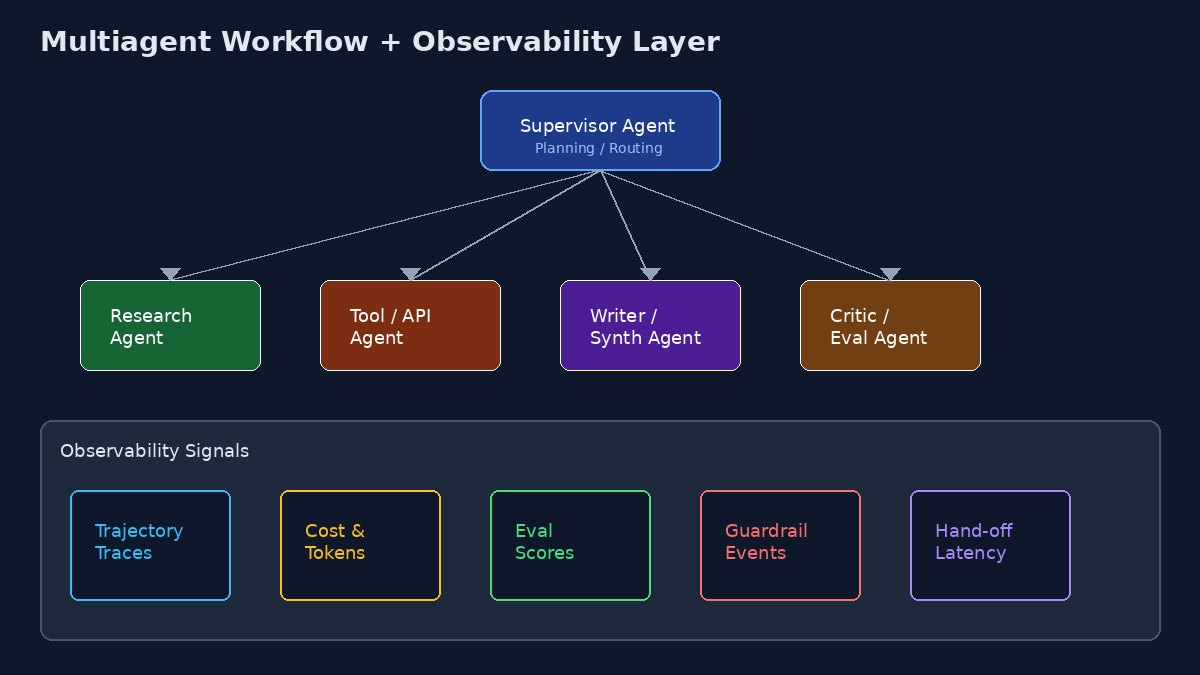
Enterprises have moved past the single-chatbot phase. Multiagent systems — where specialized agents plan, hand off work, call tools, and coordinate — are no longer experimental. They are becoming the default way teams try to turn LLMs into reliable operational capacity.
The numbers confirm the shift. Databricks' 2026 State of AI Agents report, drawn from activity across more than 20,000 organizations (including over 60% of the Fortune 500), says multi-agent workflows grew 327% in less than four months. Customer-facing work — support, onboarding, advocacy, personalized content — accounts for roughly one in four AI use cases. Gartner recorded a 1,445% surge in multiagent-system inquiries from Q1 2024 to Q2 2025 and listed multiagent systems among its top strategic technology trends for 2026. By 2027, Gartner expects 70% of these systems to rely on narrowly specialized agents.
That growth is real. The production results are not yet matching the hype.
The coordination and trust gaps
Single agents already struggle with long-horizon reliability. Multiagent setups multiply the failure surface: hand-off errors, goal drift, duplicated work, runaway retries, and opaque cost accumulation. Research and practitioner reports show failure rates on hard, realistic tasks ranging from 70% to 95%, depending on task complexity and measurement method. Gartner has predicted that more than 40% of agentic AI projects will be canceled by the end of 2027, citing escalating costs, unclear business value, and inadequate risk controls.
G2's 2026 AI Agents research adds a practical cost: the "distrust tax." Among B2B buyers, 66% now run agents in limited or scaled production. Yet 31% report employees spending six or more hours per week "bot-sitting," and 45% say oversight and rework consume more than a quarter of the productivity gains they expected. Nearly half of organizations with large agent fleets still manage them informally.
The pattern is consistent. Teams can demo multiagent flows. Moving those flows into revenue or operational systems without constant human correction remains the hard part.
| Controlled demo | Live production | |---|---| | Single happy path | Goal drift and hand-off errors | | Curated context | Missing or stale memory | | No cost pressure | Unexpected token spikes | | Human in the loop always | Bot-sitting overhead | | Success rate looks high | 70–95% failure on hard tasks |
Why observability became the missing infrastructure layer
Classic application monitoring answers "did the request succeed?" Agent observability must answer a harder set of questions: Was the reasoning sound? Did the right agent take the right action with the right tool and context? Did the hand-off preserve intent? Was the final outcome correct, safe, and cost-efficient?
Splunk's State of Observability 2026 survey of 2,050 IT and engineering professionals across ten countries makes the gap concrete:
- 87% say monitoring AI is a priority. - 54% lack clear business outcomes tied to that monitoring. - 56% cannot effectively measure core metrics such as LLM response quality. - 55% cannot accurately control AI costs; 60% report that unexpected billing spikes create more strain than high baseline spend. - 83% are concerned about unintended consequences of AI agents. - 85% consider visibility into hallucinations important, yet only 58% say they can do it effectively.
Leaders who treat observability as a first-class control plane fare better. They sample aggressively, attribute cost to specific agents and models, define ownership, and close the loop between telemetry and evaluation. Databricks reports that organizations using evaluation tools move nearly six times more AI projects into production; those using governance tools move more than twelve times more.
In short, the competitive edge is shifting from "which frontier model" to "how well can we see, evaluate, and govern the system of agents that use those models."
What production-grade multiagent observability looks like
- Full trajectory capture: not just the final answer, but every planning step, tool call, intermediate state, and inter-agent message. Trajectory-blind evaluation misses a large fraction of safety and quality failures. - Continuous, affordable evaluation: LLM-as-judge on every interaction is expensive. Purpose-built smaller evaluators and sampling strategies make grading the majority of traffic practical. Teams that only evaluate 1–5% of traffic cannot detect drift early. - Cost and policy as first-class signals: token spend, tool latency, retry loops, and policy decisions (permission denials, guardrail triggers) belong in the same dashboards as quality metrics. - Cross-agent and cross-model correlation: when a supervisor routes a sub-task to a specialist model, the observability layer must preserve the causal chain so operators can answer "which agent and which model produced this outcome?" - Human-readable accountability: session-level summaries that non-engineers can review, plus clear escalation paths when confidence drops or policy is violated.
These capabilities turn multiagent systems from black-box automation into systems that can be audited, improved, and trusted at scale.
Practical next steps for teams
- Start with narrow, high-frequency, measurable workflows rather than open-ended "digital workforce" ambitions. - Instrument every agent step from day one; retrofitting observability after production is far more expensive. - Treat evaluation suites as product assets, not one-time tests. Private, domain-specific evals are becoming a buying criterion for models and platforms. - Pair model routing and agent orchestration with explicit cost and quality SLOs. - Require a probationary period and human review gates for any agent that can take irreversible actions or touch sensitive data.
Multiagent systems are no longer a research curiosity. They are an emerging infrastructure category. Organizations that treat observability, evaluation, and governance as core product requirements will convert the current surge in experimentation into durable operational advantage. The rest will keep paying the distrust tax.
The quiet infrastructure layer that decides whether multiagent AI delivers or disappoints is no longer the models themselves. It is the ability to see, measure, and control what those agents actually do.
Sources: Databricks State of AI Agents 2026; Gartner multiagent systems research and 2026 strategic technology trends; G2 2026 AI Agents Report; Splunk State of Observability 2026. Figures are as reported by those sources as of October 2026.
Related reading: [Multi-Agent Handoffs Are Becoming the Quiet Reliability Layer for Production AI Systems](/blog/multi-agent-handoffs-production-ai-reliability) · [AI Agents Need a Reliability Scorecard](/blog/ai-agent-reliability-scorecard-outcomes-not-task-completion)