The AI Power Crunch: Why Electricity and Grid Access Could Limit AI Growth
Why electricity, grid access and public trust could become the biggest bottlenecks to AI growth
AI’s next competitive advantage may be measured not only in chips and model parameters, but in megawatts, transmission capacity, cooling water and the ability to earn permission from the communities hosting its infrastructure.
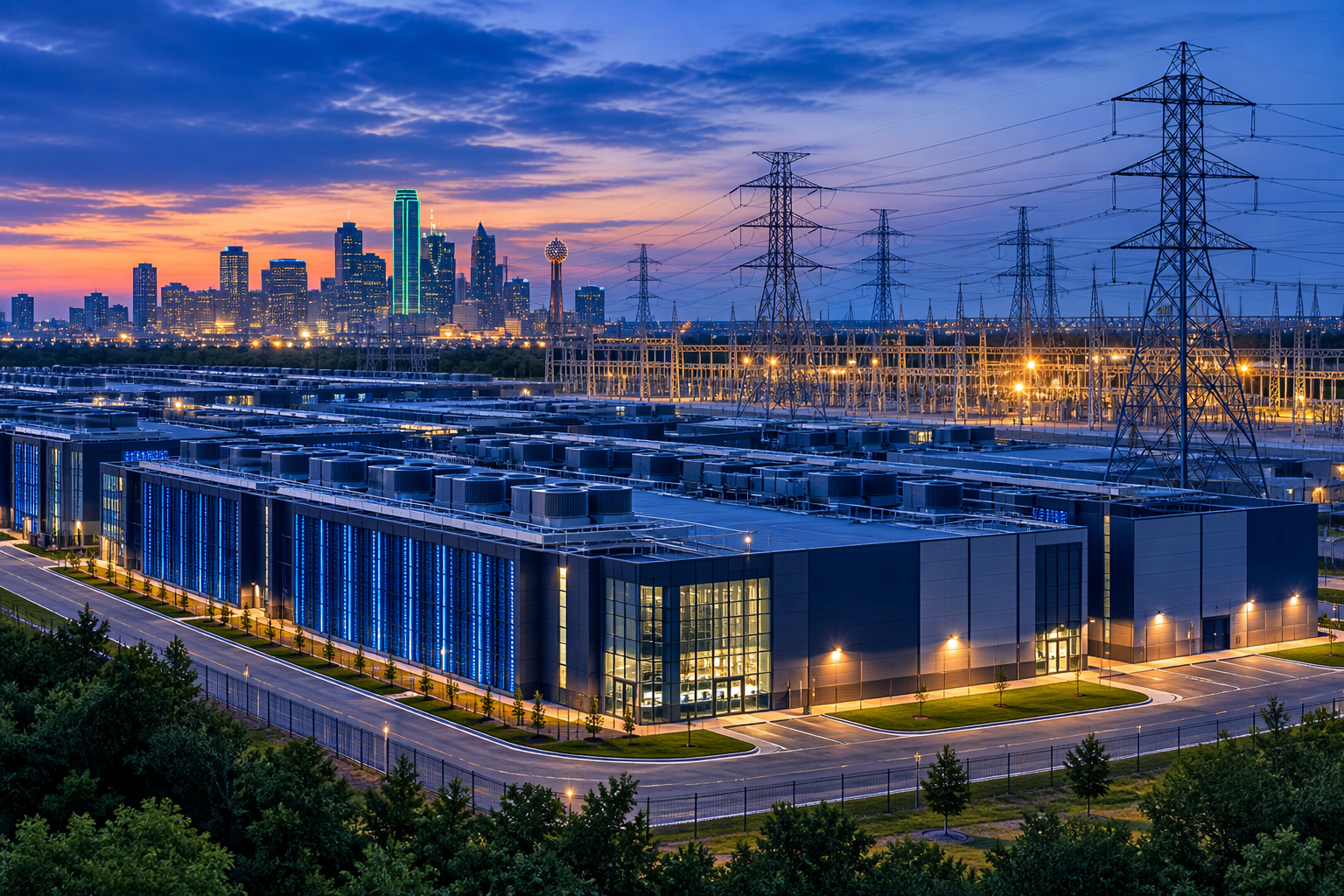
Supplied AI illustration for Reviuws; a conceptual campus, not a photograph of a documented facility.
The next AI bottleneck is physical
The AI industry has spent years competing for advanced accelerators, larger training runs and better model architectures. But a less glamorous constraint is moving toward the centre of the debate: the electricity system that must power the machines. A model can be copied across regions in minutes; a high-capacity substation, transmission line or generation project cannot.
That mismatch is becoming commercially important. Data centres are large, concentrated electricity users. Their demand must be served at a particular location, at a particular time, with high reliability. It is not enough for a country to produce plenty of electricity in aggregate if the local grid cannot deliver it to the proposed campus.
The [International Energy Agency’s updated analysis](https://www.iea.org/reports/key-questions-on-energy-and-ai/executive-summary) estimates that global data-centre electricity consumption rose 17% in 2025, while consumption at AI-focused data centres rose 50%. Its central outlook sees total data-centre consumption increasing from 485 terawatt-hours (TWh) in 2025 to about 950 TWh in 2030—roughly 3% of global electricity demand. The total and the 17% growth figure cover data centres overall; 50% describes the AI-focused subset. The 2030 figure is a projection, not a guaranteed outcome: efficiency gains, adoption rates, hardware availability and infrastructure delays could all change the path.
A forecast that changes the investment conversation
The U.S. picture is especially consequential. [Lawrence Berkeley National Laboratory’s 2025 update](https://eta-publications.lbl.gov/publications/united-states-data-center-energy-2025), published in June 2026, estimates that data centres could account for 11.8% of U.S. electricity use in 2030 in its reference case. Its sensitivity scenarios put the share at 9.5% to 15.3%. The reference-case estimate is 649 TWh, with a wider uncertainty range of 521–843 TWh. These are modeled estimates for total U.S. data-centre electricity use, not AI-only consumption. The spread matters: planners and investors should not treat one headline number as destiny.
| Outlook | Scope | Estimate | Interpretation | | --- | --- | --- | --- | | IEA 2025 estimate | Global data centres | 485 TWh | Estimated consumption | | IEA 2030 outlook | Global data centres | About 950 TWh | Projection, not a measured outcome | | LBNL 2030 reference case | U.S. data centres | 649 TWh; 11.8% of U.S. electricity | Modeled reference case | | LBNL sensitivity and uncertainty | U.S. data centres | 9.5–15.3%; 521–843 TWh | Alternative assumptions, not a single promised trajectory |
Electricity procurement and grid access are becoming strategic inputs to AI capacity. A developer may secure land, financing and chips yet still face a long wait for a connection, expensive network upgrades or uncertainty over who pays for them. Announced capacity is not the same as capacity that can be energised, economically operated and used at high utilisation.
Investors should look beyond announced gigawatts and headline capital expenditure. Is the power contracted? Is the interconnection agreement firm? Are transmission upgrades funded and scheduled? What is the exposure to congestion, curtailment and local permitting? Can the campus expand without shifting unpriced costs onto other customers?
From local objections to policy risk
On November 5, [Reuters reported](https://www.investing.com/news/stock-market-news/factboxauthorities-tighten-restrictions-on-data-centres-amid-ai-boom-5003722) government actions and proposed restrictions responding to electricity demand, water use and environmental concerns. Its factbox describes Pennsylvania’s executive order requiring safeguards and community approval, while removing data centres from the state’s fast-track permit programme. It reports a Texas pause on approvals through its grid-interconnection process while seeking more information from developers, and a one-year New York construction moratorium for data centres using at least 50 megawatts.
These are source-attributed policy examples as reported on that date, not a uniform nationwide policy or a global ban. The measures differ in legal form and scope. Their shared political question is who benefits and who bears the costs. Communities may welcome construction jobs and tax revenue while worrying about electricity bills, water demand, noise, land use and reliability.
[Reuters reported on November 6](https://www.investing.com/news/stock-market-news/democrats-planning-flood-of-ai-bills-when-they-take-control-of-congress-5007213) that Democratic lawmakers plan to introduce bills after taking control of Congress in January, including proposals aimed at protecting consumers from electricity-cost increases linked to data centres and requiring independent evaluations of leading AI systems. Those are reported legislative plans, not enacted federal requirements. Their prospects remain uncertain.
Community engagement is therefore part of project feasibility, not a public-relations exercise to schedule after site selection. A campus without durable local support may face delays, redesign costs or regulatory changes before its first server rack is installed.
The overlooked constraint: the grid is not a plug
Electricity systems are engineered networks, not unlimited sockets. A new large load can require studies, transformers, substations, transmission reinforcement and coordination with generation resources. Some equipment has long manufacturing lead times. Even where generation is available, the network may not be able to deliver it at the required reliability level.
A technology investment cycle measured in quarters can collide with power-system planning and construction measured in years. The [IEA’s Energy and AI report](https://www.iea.org/reports/energy-and-ai) highlights the different development timelines for data centres and energy infrastructure.
The answer is not simply to build more generation. It is to coordinate generation, transmission, distribution, storage and flexible demand. A new gas, nuclear, wind or solar project does not solve a local bottleneck automatically. Nor does a battery eliminate the need for adequate grid capacity. Each option has different costs, timelines, operating characteristics and environmental trade-offs.
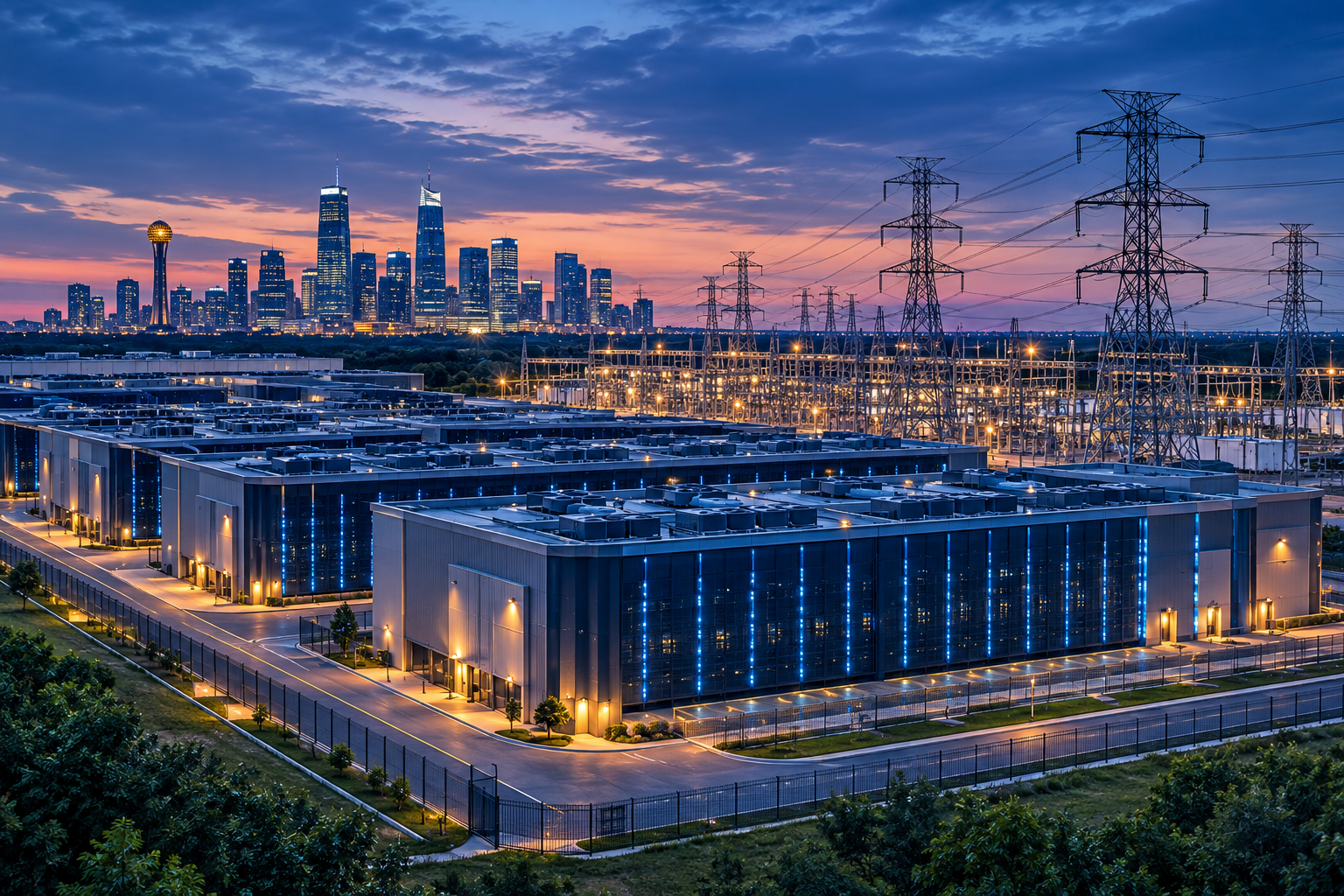
Supplied AI illustration. The infrastructure challenge spans generation, substations, transmission, cooling and surrounding communities.
Five strategies for resilient AI operators
1. Secure power before announcing capacity
Treat power as a gating item in site selection, not a post-announcement procurement task. Publish realistic timelines for interconnection, network upgrades and energisation. Investors should discount projects whose power path is only a preliminary expression of interest.
2. Design campuses to be flexible grid participants
Where feasible, operators can use batteries, thermal storage, backup generation meeting applicable emissions rules, and workload scheduling to reduce stress during constrained periods. Training jobs and other deferrable workloads may shift across time or locations; latency-sensitive inference generally has less flexibility. Flexibility should be measured and contracted, not assumed.
3. Make efficiency a board-level metric
Track energy per useful unit of computation, not only total facility consumption. Improve server utilisation, cooling design and power conversion. Smaller task-specific models, quantisation, caching and better routing can reduce unnecessary computation. Efficiency does not guarantee lower total demand—cheaper computation can stimulate more usage—but it can improve economics and reduce energy for a given workload.
4. Prove that local costs are fairly allocated
Make the allocation of grid-upgrade costs transparent. Large new loads should not quietly transfer avoidable costs or reliability risks to households and small businesses. Clear tariffs, credible demand forecasts, water plans and public reporting can reduce uncertainty for communities and capital providers.
5. Diversify the energy and location strategy
Avoid depending on one constrained grid node, one supplier or one permitting pathway. Geographic diversification, multiple supply arrangements and staged development can reduce concentration risk. Moving to a new region is not a substitute for assessing its water availability, grid conditions and community consent.
What this means for AI users and businesses
Businesses buying AI services may encounter higher or more volatile infrastructure costs, regional capacity constraints, changes in service availability or a greater emphasis on efficiency. Procurement teams should ask about regional redundancy, service-level commitments, energy sourcing and capacity shortages.
For consumers, the key question is whether expansion costs are allocated transparently. A data centre can create economic value, but that value must be weighed against its demands on shared systems. Reliable disclosure distinguishes well-planned investments from speculative projects whose costs are pushed onto the public.
For AI companies, energy belongs in product design. Model choice, inference architecture, placement, caching and scheduling affect the amount and timing of electricity required. The most competitive system may deliver the required quality with the least scarce compute and the most reliable power, rather than using the largest model for every task.
The bottom line: AI needs a social licence to scale
The AI race is not only a contest between chipmakers, cloud providers and model developers. Utilities, grid operators, equipment manufacturers, regulators, local governments and residents will also shape it. Electricity is not merely an operating expense; its availability depends on physical infrastructure and public consent.
The demand outlook and reported policy developments do not prove AI growth will stop. They show that growth is becoming more conditional. Projects that secure credible power, use it efficiently, disclose their impacts and share benefits should be better positioned than projects built on optimistic assumptions.
The next AI advantage may not be another benchmark point. It may be the ability to turn a megawatt into dependable, affordable and socially acceptable computation.
Sources and editorial notes
- [IEA: Key Questions on Energy and AI, executive summary](https://www.iea.org/reports/key-questions-on-energy-and-ai/executive-summary) — global estimates and projections; total data centres and AI-focused growth are distinct. - [LBNL: United States Data Center Energy Usage Report, 2025 Update](https://eta-publications.lbl.gov/publications/united-states-data-center-energy-2025) — June 2026; modeled U.S. 2030 reference and sensitivity scenarios. - [Reuters: Authorities tighten restrictions on data centres](https://www.investing.com/news/stock-market-news/factboxauthorities-tighten-restrictions-on-data-centres-amid-ai-boom-5003722) — November 5, 2026; policy examples attributed to reporting, not an independent legal audit. - [Reuters: Democrats planning AI bills](https://www.investing.com/news/stock-market-news/democrats-planning-flood-of-ai-bills-when-they-take-control-of-congress-5007213) — November 6, 2026; proposed legislation, not enacted law. - [IEA: Energy and AI](https://www.iea.org/reports/energy-and-ai) — infrastructure and lead-time context.
Reviewed November 7, 2026. Forecasts remain conditional; policy reporting may change. Supplied illustrations are conceptual, not evidence of specific sites.
Related reading
- [Who Will Win the AI Infrastructure Race: US, China or EU?](https://reviuws.com/blog/ai-infrastructure-race-us-china-eu-2026) - [AI Research](https://reviuws.com/ai-research)
Referenced sources
- Illustrated data-centre campus connected to substations and transmission infrastructure
- International Energy Agency’s updated analysis
- Lawrence Berkeley National Laboratory’s 2025 update
- Reuters reported
- Reuters reported on November 6
- IEA’s Energy and AI report
- Conceptual illustration of a data-centre campus beside a transmission network and city
- IEA: Key Questions on Energy and AI, executive summary
- LBNL: United States Data Center Energy Usage Report, 2025 Update
- Reuters: Authorities tighten restrictions on data centres
- Reuters: Democrats planning AI bills
- IEA: Energy and AI
- Who Will Win the AI Infrastructure Race: US, China or EU?
- AI Research