Who Will Win the AI Infrastructure Race: US, China or EU?

The next AI superpower will not be decided by models alone. Chips, electricity, data centres, capital and supply-chain resilience will determine who can build and run AI at scale.
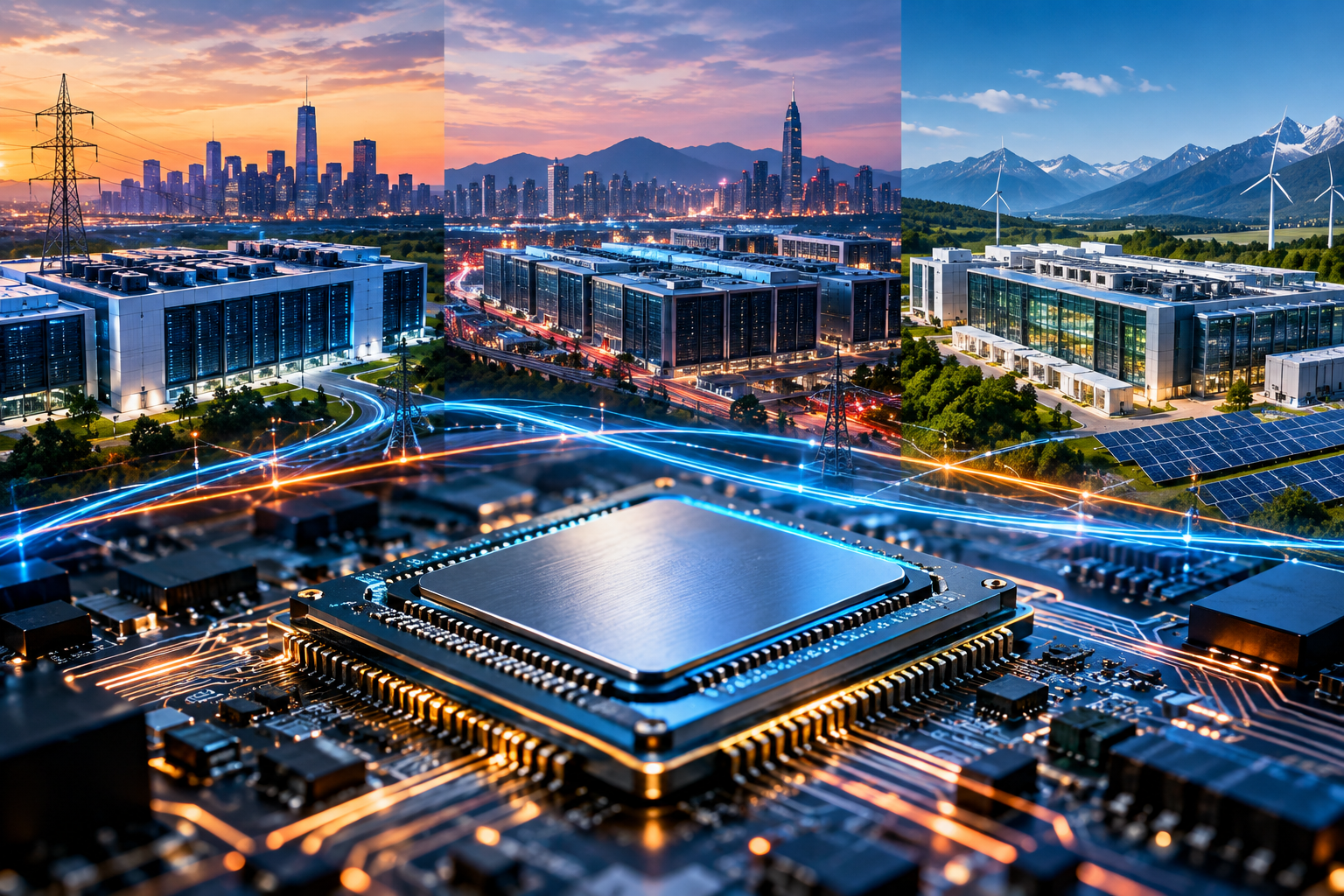
AI-generated editorial illustration.
The verdict in brief
The United States is the frontrunner for the next three to five years. It combines a deep pool of private capital, leading cloud platforms, advanced AI-chip access and the world's largest concentration of data centres. China is the strongest challenger, with enormous industrial capacity, a large domestic market, growing home-grown chip efforts and an ability to mobilise energy and infrastructure at scale. The European Union is not currently positioned to win a head-to-head race for raw compute, but it can become a consequential third pole if it turns announced investment into operating capacity.
This is a forecast, not a claim that one region will win every layer. The most defensible conclusion is that the US leads today on frontier-scale compute and private investment; China is closing gaps in selected areas; and Europe's outcome depends heavily on execution.
1. What counts as winning?
A durable advantage requires more than the biggest data-centre footprint. This analysis assesses five connected layers:
- Compute and chips: access to accelerators, advanced memory and networking, and the ability to manufacture or procure them. - Capital: the ability to finance repeated generations of expensive equipment. - Power and sites: electricity, grid connections, cooling and permits. - Supply-chain resilience: control over critical components and exposure to geopolitical chokepoints. - Deployment: whether infrastructure is affordable, utilised and available to researchers, businesses and public services.
A country can lead one layer and lag another. Chip design, fabrication, packaging and data-centre ownership are spread across borders; treating them as a single national asset would overstate any one region's self-sufficiency.
2. The United States: the current leader, with a power problem
The clearest advantage is scale. Stanford HAI's 2026 AI Index reports that the United States hosted 5,427 data centres, more than ten times any other country. The same report says US private AI investment reached $285.9 billion in 2025, versus $12.4 billion in China and $20.9 billion in Europe. These are private-investment figures, not a complete measure of national spending: they do not fully capture state-directed finance.
A Federal Reserve analysis published in October 2025 estimated 4,049 US data centres in 2024, compared with about 2,250 in the EU and 379 in China. Datasets, dates and definitions differ, so cross-source counts should be read as directional rather than perfectly comparable.
The US also benefits from cloud platforms that can finance and operate huge clusters and a strong ecosystem of AI-chip designers. Its reliance on international supply chains is also a vulnerability: Stanford notes that almost every leading AI chip is fabricated by one Taiwanese foundry, TSMC.
The constraint is power and delivery. The International Energy Agency estimated that data centres consumed about 415 TWh of electricity globally in 2024, around 1.5% of global electricity use, and projected roughly 945 TWh by 2030. Investment only becomes compute when substations, transmission, generation, cooling and servers are actually online.
3. China: the scale challenger
China can mobilise large industrial supply chains, build infrastructure rapidly, and connect AI development to manufacturing, logistics, consumer platforms and public-sector deployment. Recent analyses describe Chinese models competing more closely with US models on several tasks, often at lower cost.
Export controls on advanced chips and chipmaking equipment have limited some routes to the highest-end hardware, but they have also intensified the push for domestic alternatives. A March 2026 CSIS analysis argues that restrictions have accelerated China's semiconductor-localisation drive, even as access to leading-edge equipment remains a challenge. Less access to a particular chip can slow frontier training, while software efficiency and domestic deployment can still improve quickly.
National generation totals do not automatically equal power available at the right site, at the right time, with the grid connection and cooling an AI cluster needs.
China's path to victory: make domestic accelerators good enough and available at scale, keep improving model efficiency, and convert industrial capacity into widely deployed AI.
4. The European Union: a credible third pole, but an execution race
Europe starts from a weaker position. The Federal Reserve's comparison found that the US added 5.8 GW of data-centre capacity in 2024, compared with 1.6 GW in the EU.
The EU is responding. In July 2026, the European Commission launched a call to establish up to seven AI Gigafactories, supported by up to €10 billion in EU and national funding and expected to unlock at least €20 billion in private investment, complementing a network of 19 AI Factories. Those figures describe an initiative and expected financing, not completed facilities.
Europe's advantages include a strong industrial base, world-class research, energy and grid expertise, and a trusted market for AI under EU rules. These could make it competitive in industrial AI: manufacturing, engineering, healthcare, climate and scientific computing. The risks are fragmented markets, slow permitting and grid connections, dependence on external chip suppliers, and a gap between announced funding and delivered infrastructure.
5. The scorecard: who leads each layer?
| Layer | US | China | EU | |---|---|---|---| | Frontier-scale compute today | Leads | Strong challenger; gap remains | Behind US and China at scale | | Private AI capital | Clear lead in reported private investment | Smaller reported private total; state role matters | Smaller reported private total | | Advanced chip ecosystem | Strong design and cloud ecosystem; relies on global fabrication | Domestic capability growing; leading-edge constraints | Equipment and research strengths; limited full-stack autonomy | | Power and build-out | Large investment; grid bottlenecks | Large industrial and power build-out; local constraints | Clean-energy potential; permitting challenges | | Strategic advantage | Capital, cloud platforms, chip access | Scale, industrial deployment, localisation | Industrial AI, trusted infrastructure |
A qualitative synthesis of the cited evidence, not a numerical index.
6. The next decisive battlegrounds
Electricity, grids and time-to-power
The decisive metric may become time-to-power: how quickly a project can secure a grid connection and reliable supply. The IEA estimates new transmission lines can take four to eight years to build in advanced economies.
Chip supply and system efficiency
The race is about the cost of useful output per watt and per dollar. Better architectures, quantisation, memory bandwidth, networking, cooling and utilisation can stretch scarce compute.
From announcements to operating capacity
Investment pledges should be discounted until projects are financed, permitted, powered, equipped and operating at meaningful utilisation. That applies to the EU Gigafactories, US hyperscaler plans and Chinese build-outs alike.
A more fragmented technology stack
BCG's June 2026 analysis describes US and Chinese AI ecosystems as increasingly distinct, with the EU pursuing more sovereign compute. Open standards, portability and multi-region architecture will matter to companies that want flexibility.
7. Final prediction: US first, China closing, EU specialised
Through roughly 2030, the most likely outcome is a US lead in frontier-scale AI infrastructure, an increasingly capable and cost-competitive Chinese ecosystem, and an EU position built around strategic capacity and high-value industrial applications. Three indicators will show whether this forecast is changing:
- Operating AI compute, not announced projects, coming online each year. - Reliable power delivered to data centres, including grid connections and utilisation. - The performance, availability and total cost of domestic or alternative chips in real workloads.
The real winner will be the region that turns chips, capital and electricity into reliable, affordable intelligence at scale. On today's evidence, the US has the strongest starting position, China has the clearest route to challenge it, and the EU still has a route to relevance if it builds faster.
Sources
- [Stanford HAI, 2026 AI Index Report](https://hai.stanford.edu/ai-index/2026-ai-index-report) - [Federal Reserve, The State of AI Competition in Advanced Economies (Oct 2025)](https://www.federalreserve.gov/econres/notes/feds-notes/the-state-of-ai-competition-in-advanced-economies-20251006.html) - [Federal Reserve, The Global Trade Effects of the AI Infrastructure Boom (Feb 2026)](https://www.federalreserve.gov/econres/notes/feds-notes/the-global-trade-effects-of-the-ai-infrastructure-boom-20260213.html) - [IEA, Energy and AI](https://www.iea.org/reports/energy-and-ai/executive-summary) - [European Commission, AI Gigafactories](https://commission.europa.eu/topics/competitiveness/competitiveness-coordination-tool-projects/ai-gigafactories_en) - [European Commission, EU launches AI Gigafactories call (Jul 2026)](https://digital-strategy.ec.europa.eu/en/news/eu-launches-ai-gigafactories-call-boost-europes-computing-capacity-and-unlock-more-eu30-billion) - [CSIS, China's Localization Drive in Semiconductors (Mar 2026)](https://www.csis.org/analysis/chinas-localization-drive-semiconductors-gains-impetus-allied-chip-export-controls) - [BCG, The Great Divide (Jun 2026)](https://www.bcg.com/publications/2026/us-and-china-ai-strategy-causing-global-ai-divide)
Editorial note: an evidence-based forecast, not investment advice. Data-centre counts, capacity, AI-only compute and planned investment are different measures.
Referenced sources
- AI infrastructure as a whole-system contest: chips, data centres, networks, cooling and electricity
- Europe's AI infrastructure at the intersection of compute, energy and industry
- Stanford HAI, 2026 AI Index Report
- Federal Reserve, The State of AI Competition in Advanced Economies (Oct 2025)
- Federal Reserve, The Global Trade Effects of the AI Infrastructure Boom (Feb 2026)
- IEA, Energy and AI
- European Commission, AI Gigafactories
- European Commission, EU launches AI Gigafactories call (Jul 2026)
- CSIS, China's Localization Drive in Semiconductors (Mar 2026)
- BCG, The Great Divide (Jun 2026)